Guangdong Province
🦆 Guangzhou
The birthplace of Cantonese cuisine and the engine of China's southern economy. Guangzhou's dim sum culture, Pearl River night cruises, and proximity to Hong Kong (1 hour by high-speed rail) make it an essential southern China stop.
- ⭐ FIT Rating
- 8/10
- 🕐 Ideal Stay
- 2–3 days
- 🗣️ English
- Medium — strong in business and hotel districts
- 📱 Digital
- Excellent
Why this city
Guangzhou is the city that feeds China. Cantonese cuisine — dim sum, roast meats, seafood, congee, wonton noodles — originated here and remains most authentically represented here. The morning tea ritual (饮茶, yum cha) is not a tourist attraction but a daily institution: a multi-generational meal that functions as the city’s primary social glue. You’ll spend 90 minutes at a table with strangers and leave having had the most distinctly Chinese meal of your trip, even if you can’t identify half of what you ate.
Guangzhou is also a different register of China from Beijing or Shanghai. Cantonese culture — with its emphasis on business practicality, its softer approach to face and hierarchy, and its historical orientation toward Hong Kong and Southeast Asia rather than the imperial north — shapes a city that feels simultaneously less formal and more knowing than its counterparts. The architecture is denser and less curated than Shanghai; the streets are louder; the history is written in trade rather than empire. This is the city that ran the Canton System for 200 years, funneling all Western trade through a single controlled port. That commercial confidence still runs through it.
A practical note: Guangzhou is subtropical. May through September is hot (35°C+), very humid, and subject to typhoon disruptions from June onwards. October through April is when the city is at its best — warm enough to eat and walk comfortably, cool enough to want a second round of roast goose.
The signature experiences
Yum cha at a traditional teahouse. This is the defining Guangzhou experience and the first thing to do on your first morning. Find a large local teahouse — not a tourist dim sum restaurant, but the kind of place where elderly men read newspapers and order by ticking items on a paper slip. Arrive at 8–9am. Order cha siu bao, har gau, cheung fun, and whatever the trolley brings past. Budget two hours and ¥60–100 per person. Recommendations: Lianxianglou (莲香楼, the oldest), Guangzhou Restaurant (广州酒家), or any teahouse in the Liwan district where locals actually go.
Shamian Island. A small island in the Pearl River delta that was divided between British and French concessions from 1859 to 1949. The European architecture — tree-lined boulevards, colonial-era consulates, churches — is unusually intact and offers a striking visual contrast to the surrounding city. Quiet, walkable, and far less touristed than Shanghai’s Bund. A morning walk here is one of Guangzhou’s most underrated hours.
Chen Clan Ancestral Hall (陈家祠). A late Qing dynasty clan temple that is one of the finest examples of Cantonese folk architecture anywhere. The ceramic ridge decorations, wood carvings, and stone friezes cover every surface in intricate detail. The contrast between this and the surrounding modern streets is a useful summary of Guangzhou’s layered character. Allow 90 minutes.
Canton Tower. At 600 metres, it was briefly the world’s tallest TV tower and is still the most distinctive structure on the Guangzhou skyline. The observation deck on the 107th floor is spectacular; the bubble tram around the outside is not worth the premium. Better as an evening visit when the Pearl River and surrounding districts are illuminated.
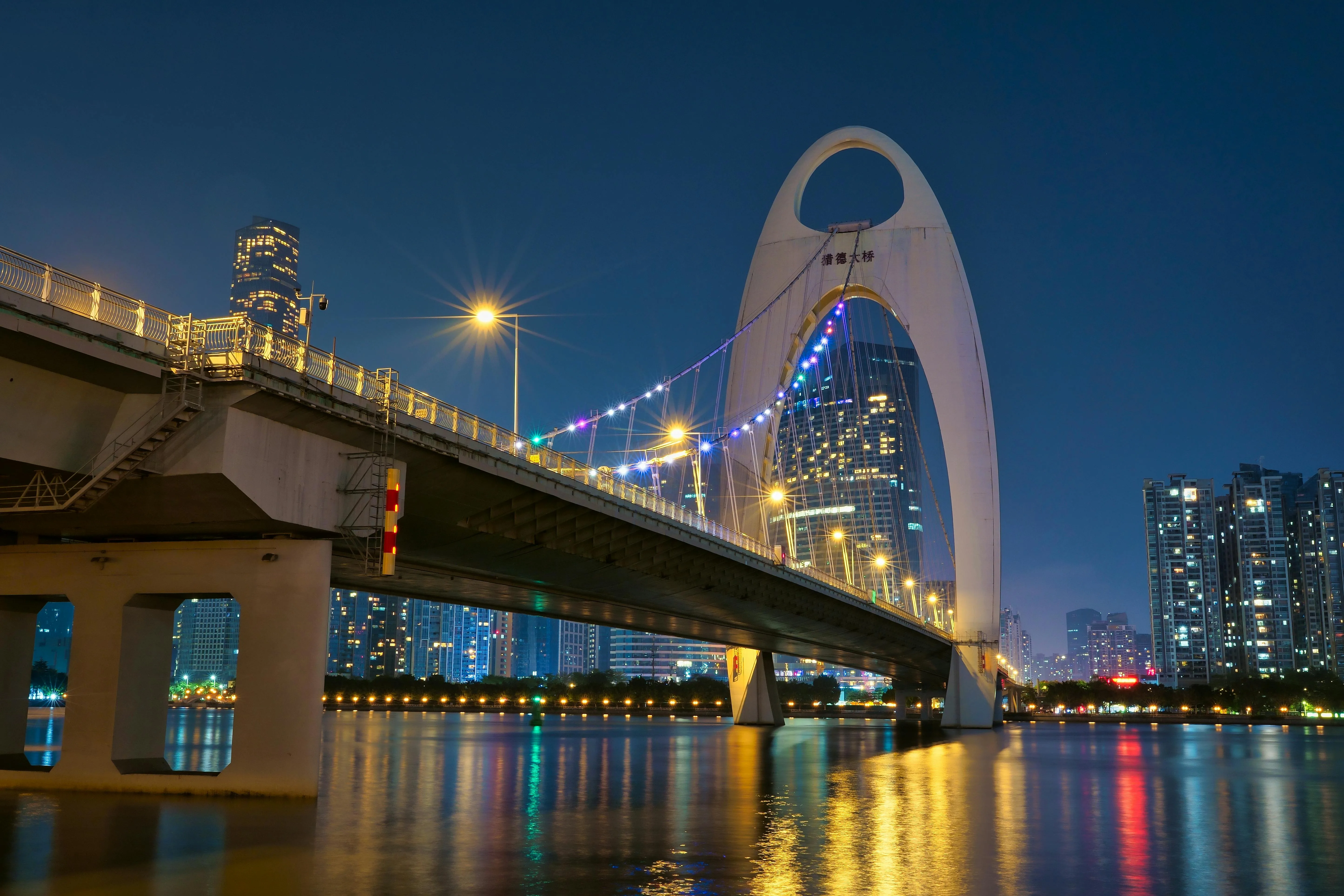
Pearl River night cruise. The standard one-hour cruise passes Canton Tower, the Haixinsha island festival venue, and the financial district. The illuminations are well done by Chinese city standards. Book through your hotel or at the Tianzi dock; departs every 30–60 minutes from 7pm. Budget ¥100–150 per person.
Yuexiu Park. The largest park in central Guangzhou and the site of the Five Rams Statue — the most recognizable symbol of the city, based on a founding myth. The Zhenhai Tower (Ming dynasty, now a city museum) occupies the highest point. Used heavily by local residents for morning exercise, which makes it one of the better places to observe daily Guangzhou life.
Shangxiajiu Pedestrian Street and Liwan district. The old commercial heart of the city — pre-modern shophouses converted into a pedestrianized retail and food street. Crowded, loud, and excellent for street food. Best on weekend afternoons when it is fully alive; the side streets of Liwan district around Yong’an Street are where the genuinely old Cantonese street culture survives.
The neighborhoods
Yuexiu. The historic core of Guangzhou — the oldest district, most of the significant historical sites, and the densest street-level culture. Shamian Island is an extension of Yuexiu to the south. Hotels here tend to be mid-range and locally-owned; the area is walkable and metro-connected. Best for first-time visitors who want to spend time in genuinely Cantonese streets.
Liwan. West of Yuexiu, older and less touristed. The antique markets on Dadao Zhonglu are worth a morning browse; the congee and wonton noodle restaurants on the side streets represent Guangzhou food culture at its most unmediated. Feels more working-class and less curated than Yuexiu.
Tianhe. The modern CBD, built since the 1980s in what was farmland. The Citic Plaza, Grandview Mall, and Teemall shopping complexes are here. Architecturally undistinguished but practically convenient — most international chain hotels are in Tianhe, metro connections are excellent, and Tianhe South 2 station is one of the busiest in the system. Where you end up if you book on business.
Zhujiang New Town. Guangzhou’s showcase modern district, developed since 2000. The Guangdong Museum (Rocco Yim, 2010), the Guangzhou Opera House (Zaha Hadid, 2010), and the Guangzhou International Finance Centre are all here. A deliberate statement about the city’s ambitions. The riverfront boulevard is excellent for walking and the Opera House is worth a ticket regardless of what’s performing.
Haizhu. South of the Pearl River, large and mostly residential. The Creative Industry Park (Redtory) is a converted factory complex with galleries and cafés. Less reason to visit unless you’re staying here, but the canal market areas near Jiangnanxi metro are some of the best morning street food territory in the city.
Food
Guangzhou is the best food city in China. This is a contested claim — Chengdu argues on the basis of flavour intensity and Shunde argues on the basis of culinary tradition — but for sheer breadth, quality, and the integration of food into daily social life, Guangzhou has few peers anywhere in the world.
Dim sum (点心) is mandatory and vast. The category covers hundreds of distinct dishes across baked, steamed, deep-fried, and pan-fried preparations. The essentials for a first visit: har gau (steamed shrimp dumplings), siu mai (pork and shrimp topped with roe), cha siu bao (roast pork buns, baked and steamed versions are different dishes), cheung fun (rice noodle rolls, with shrimp or cha siu), dan tat (egg tarts), and lo bak go (turnip cake, pan-fried). These are all available at any traditional teahouse.
Roasted goose (烧鹅, shāo é) is the centrepiece of Cantonese roast meat culture. The skin should shatter; the meat should be both juicy and flavourful. Bingsheng and Yung Kee (now Yung’s) are the famous names; any roast meat shop with a queue of local customers will serve a version worth eating.
White-cut chicken (白切鸡, bái qiē jī) demonstrates how much Cantonese cooking values ingredients over technique. The chicken is poached at just below boiling, rested, and served at room temperature with ginger-scallion oil. It should taste like the best chicken you’ve ever eaten, or the kitchen is cutting corners.
Congee (粥, zhōu) is the Cantonese breakfast of choice when dim sum is not on the table. A slow-cooked rice porridge served with a range of toppings — century egg and pork, fish and ginger, dried scallop. The Cantonese version is silkier and more neutral than northern congee. Any congee specialist restaurant open before 9am will be using fresh ingredients.
Wonton noodles (云吞面, yún tūn miàn) should be eaten in a bowl small enough that the broth stays hot. The prawns inside the wontons should be whole. The noodles should be springy, slightly alkaline, and cooked in two minutes flat. Budget ¥15–25; anything more expensive is charging for atmosphere.
For an elevated dinner, the restaurant complexes inside the Guangdong Museum of Art and along Jianshe Liu Malu in Yuexiu are clustered with both Cantonese fine dining and well-regarded regional Chinese cuisine from around the country. For seafood, the tanks-to-table restaurants in the Haizhu district wholesale market are extraordinary value.
Getting around
Metro. Guangzhou’s metro system has 16+ lines and covers virtually every part of the city worth visiting. Fares run ¥2–10; pay with Alipay QR code or a physical transit card from any station. Airport Line 3 connects Baiyun Airport to the metro network in 35 minutes. Line 2 and Line 3 cover Yuexiu and most of the central tourist area. Zhujiang New Town is on Line 3 and Line 5.
Didi. Works exactly as in other Chinese cities — book through the Didi mini-program in Alipay. Particularly useful in the evenings when walking is uncomfortable in the heat, and for getting to and from the waterfront destinations that are farther from metro stations.
Walking. Yuexiu, Shamian Island, and Liwan are all compact enough for walking. Shamian Island is 800 metres long and completely walkable. The old city core between Yuexiu metro and Shamian is 25 minutes on foot. Tianhe and Zhujiang New Town are metro-optimised and less pleasant to walk.
High-speed rail. Guangzhou South station is the hub for connections to Hong Kong (48 minutes to West Kowloon), Shenzhen (30 minutes), Guilin (2.5 hours), and Changsha. Guangzhou East station handles intercity trains and some regional services. Both connect to the metro network.
Ferry. A ferry service connects Guangzhou to Hong Kong’s port terminals — roughly 80 minutes, useful if arriving by cruise or wanting to avoid the city.
A 48-hour itinerary
Day 1 — Old Guangzhou.
- Morning (8:00–10:00am). Yum cha at Lianxianglou or Guangzhou Restaurant. Take your time — this is the meal of the trip.
- Mid-morning. Walk Shamian Island. The old colonial buildings are best in morning light.
- Lunch. Chen Clan Ancestral Hall area — several good Cantonese lunch restaurants on Zhongshan 7th Road nearby.
- Afternoon. Chen Clan Ancestral Hall (90 minutes). Walk east through Liwan toward Shangxiajiu Street for street food browsing.
- Evening. Pearl River night cruise (departs from Tianzi wharf from 7pm). Return to the Zhujiang New Town riverfront for a walk and a drink.
Day 2 — Modern Guangzhou and departure.
- Morning. Yuexiu Park for the morning exercise culture, then Zhenhai Tower museum.
- Late morning. Canton Tower viewing (best before afternoon haze builds up).
- Lunch. Roast goose at Bingsheng or a local roast meat specialist.
- Afternoon. Depending on departure — either Guangdong Museum in Zhujiang New Town, or a final street food sweep through Haizhu before heading to the airport or onward train.
A 5-day itinerary
Day 1. Arrive. Yum cha breakfast the following morning; evening Pearl River cruise.
Day 2. Shamian Island, Chen Clan Ancestral Hall, Liwan district food tour.
Day 3. Day trip to Shunde (顺德, 30 minutes by metro/bus) — considered by many Cantonese cooks to be where Cantonese cuisine originates. The Dalingshan food street and the Qinghui Garden are the principal draws. Return to Guangzhou for dinner.
Day 4. Day trip to Hong Kong (48 minutes by high-speed rail to West Kowloon). Full day in Hong Kong, return in the evening.
Day 5. Canton Tower, Zhujiang New Town and Guangzhou Opera House, final dim sum lunch, departure.
Day trips
Hong Kong (48 minutes by high-speed rail from Guangzhou South). A full day in Hong Kong is viable — the train is so fast that arrival by 10am and departure by 9pm is comfortable. Victoria Harbour, Tsim Sha Tsui, and the Central–Mid-Levels escalator cover the essentials.
Shunde (顺德, 30–45 minutes). Considered by Cantonese chefs to be the spiritual origin of their cuisine. Visits to a working kitchen at one of the town’s famous restaurants are occasionally available; the food market alone justifies the day trip.
Foshan (20 minutes by metro, Line 2 crosses the boundary). The city that produced Bruce Lee’s Wing Chun kung fu tradition. The Ancestral Temple (祖庙, Zumiao) is outstanding; the nearby cultural quarter has demonstrations and museums dedicated to the martial arts traditions.
Zhuhai and Macau (90 minutes by bus/rail). Zhuhai connects to Macau by ferry or the Hong Kong–Zhuhai–Macau Bridge. A Macau day trip from Guangzhou requires an early start; better as an overnight if the casinos and Portuguese architecture are priorities.
Guilin (2.5 hours by high-speed rail). The southern anchor of the Guangzhou–Guilin circuit that works well as a 5–7 day route through southern China.
Culture and etiquette
Cantonese versus Mandarin China. Guangzhou is not culturally Mandarin. Cantonese (粤语, Yuè yǔ) is the first language of most residents, and while everyone speaks Mandarin as a second language, defaulting to it with older locals can feel slightly presumptuous. “Ng goi” (唔該, excuse me/thank you in Cantonese) and “M̀h goi” for thanks go further here than “xie xie.”
The morning tea ritual. Yum cha is not a quick meal. It is a social occasion that may take 90 minutes to two hours, with tea being constantly replenished and dishes arriving on trolleys or from a tick-box order slip. The correct approach is to sit, pour tea for others before yourself, and let the pace be set by the room. Asking for the bill before other tables in your group have finished eating is slightly rude.
Business culture. Guangzhou is one of China’s most commercially sophisticated cities. The Canton Fair — held twice yearly — brings tens of thousands of international trade buyers. In business contexts, Cantonese directness (lower-context communication than Mandarin business culture) and a quicker tolerance for getting to the point are noticeable.
Food photography. Photographing food at yum cha is universally understood and nobody will mind. What is slightly less appreciated is loudly commenting on food quality in a teahouse — local pride in Cantonese cuisine is considerable, and a foreigner publicly comparing it unfavourably to something they had elsewhere will land with a slight coolness.
Common scams
Tourist restaurant overpricing near Shamian Island. The restaurants directly on Shamian Island targeting foreigners can charge three to four times market rate for mediocre Cantonese food. Walk north over the bridge into Liwan for the equivalent meal at a third of the price.
Antique and jade shops near Chen Clan Ancestral Hall. The area around the Ancestral Hall has high concentrations of “antique” shops selling recent reproductions as Ming and Qing dynasty pieces. Genuine antiques exist, but the pricing and provenance claims almost never correspond to reality. Buy ceramics and artwork for aesthetic reasons, not as investment pieces, unless you have specific expertise.
Inflated tour pricing at Canton Tower. Tours sold outside the tower frequently bundle the observation deck ticket with experiences (bubble tram, skywalk) that cost more than the ticket itself and are of limited value. Buy the observation deck ticket directly at the tower; skip the add-ons.
Taxi overcharging from the main train stations. Guangzhou South and East stations attract unofficial taxis at major exits. Use Didi or the official taxi queue marked in Chinese (正规出租车). Guangzhou South to Yuexiu should cost under ¥80; unofficial quotes of ¥200+ are standard practice.
What surprises first-time visitors
How different Cantonese feels from Mandarin China. Most visitors who have been to Beijing or Shanghai arrive expecting Guangzhou to be broadly similar. The language, the food culture, the pace of commercial life, and the orientation toward Hong Kong and Southeast Asia rather than the imperial north make it feel genuinely distinct.
Hong Kong is 48 minutes away. The high-speed rail link that opened in 2018 is fast enough to make Hong Kong feel like a suburb of Guangzhou. Many visitors add a Hong Kong day trip as an afterthought and find it reshapes their understanding of the region entirely.
The heat. Guangzhou is subtropical. In June through September, the combination of 35°C temperatures and 90% humidity is genuinely physically demanding. Skin air-conditioned malls and metro stations exist as survival strategy; all outdoor sightseeing should be done before 11am or after 5pm.
How seriously locals take food. The statement “Cantonese people eat anything” is a cliché but the underlying truth is that food quality is evaluated here with a seriousness that differs from other Chinese cities. A Guangzhou resident who tells you a restaurant is mediocre is giving you precise information, not false modesty.
The city’s physical scale. Guangzhou is one of the largest cities in the world by population in the metro area. The distance from Baiyun Airport to Yuexiu city center is 25 kilometres; from Yuexiu to Guangzhou South station is another 25. Without the metro, it would be effectively unnavigable.
Where this fits in a first China trip
Guangzhou works best as the anchor for a southern China itinerary rather than as a node in the standard Beijing–Xi’an–Shanghai circuit.
The strongest southern China loop is Guangzhou → Guilin → Yangshuo → Hong Kong (or in reverse), spending 2–3 days in each. This covers the best food city, the most dramatic landscape, and the most internationally-oriented city in a 10–12 day circuit that requires minimal backtracking.
Guangzhou also pairs naturally with Shenzhen (30 minutes north by HSR) for anyone with hardware, tech, or manufacturing interests — the two cities are functionally one conurbation from an economic perspective.
For the standard first China trip focused on Beijing–Xi’an–Shanghai: Guangzhou is a good add-on if you’re flying home via Hong Kong, extending the trip by two days from the southern end. It is less compelling as a detour from a northern circuit that terminates in Shanghai.
The honest first-trip calculus: if you are a food-serious traveler, Guangzhou may be the most important city on the list — the food culture here is simply not replicable anywhere else. If food is not a priority, Beijing, Xi’an, and Shanghai cover the historical and cultural ground more efficiently.