Shandong Province
🍺 Qingdao
Germany's colonial legacy gave Qingdao its red-roofed Bavarian architecture, Tsingtao Brewery, and one of China's most photogenic waterfronts. In summer it hosts international sailing events; year-round, its seafood markets and beer gardens are a genuine draw.
- ⭐ FIT Rating
- 8/10
- 🕐 Ideal Stay
- 2–3 days
- 🗣️ English
- Low to medium — tourist areas have English signage
- 📱 Digital
- Good
Why this city
Qingdao is the most visually unexpected city in China. Where every other Chinese coastal city presents the same vocabulary of concrete towers and neon signage, Qingdao’s historic district reads as German. Red-tiled roofs, Bavarian gables, granite-faced civic buildings, a Lutheran church with a copper spire: the Kaiser Wilhelm era left an architectural legacy that survived because nobody had a strong reason to demolish it, and the city has since understood that what it has is unusual enough to be worth preserving.
The beer and the architecture are related. Tsingtao Brewery was founded in 1903 by German and British investors to serve the colonial population and the railway workers building the Jiaozhou–Jinan line. The brand outlasted its founders by over a century; the brewery is still operating on its original site. The draft version served in local restaurants from a green plastic bag — the traditional Qingdao delivery method — tastes materially different from the bottled version exported everywhere else.
What makes a Qingdao visit worth the journey is the combination: seafood caught in the Yellow Sea and sold directly at harbour-side markets, an old European town compact enough to walk in a morning, and a beach infrastructure that serves domestic tourists in summer and empties dramatically in the shoulder season. The city rewards visitors who arrive in May or September and find the beaches relatively uncrowded and the seafood markets fully stocked. July and August are when half of northern China arrives for summer holidays; the city at those times is a different, and considerably less pleasant, proposition.
The signature experiences
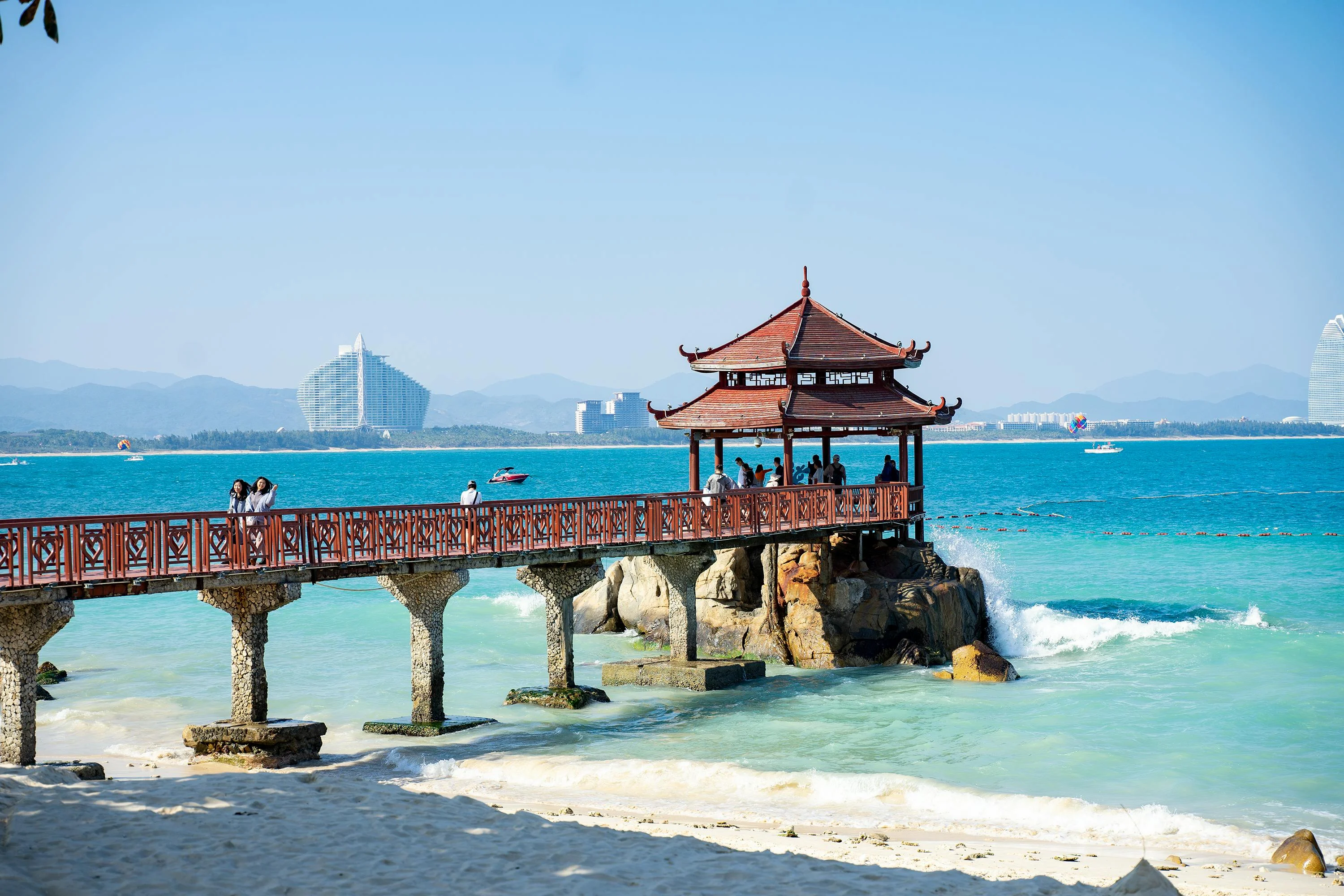
Zhanqiao Pier (栈桥). The defining image of Qingdao — a 440-metre pier stretching into the bay, terminating in the Huilan Pavilion, with the red-roofed old city rising behind it. At golden hour, the combination of light, architecture, and water produces the most photographed scene in the city. Arrive 45 minutes before sunset; the crowds peak at and immediately after sunset, so the 30 minutes before full dark is both the most beautiful and the most crowded. A second visit at 7am is empty and equally beautiful.
Badaguan (八大关). A residential neighbourhood of eight streets intersecting like a chess board, each named for a different mountain pass and lined with a different species of tree. The buildings on these streets — built between the 1900s and 1940s — represent every major European architectural style of the period: English Gothic, German Baroque, Russian Orthodox, Danish Art Nouveau, Spanish Mission. No single building is a major attraction; the district as a whole is. Walk it without a plan.
Tsingtao Brewery Museum (青岛啤酒博物馆). The original 1903 brewing complex converted into a museum covering the brewery’s full history, including its German and Japanese ownership periods. The entry ticket includes beer samples; the premium ticket includes more of them. The tour ends in the beer garden where draft Tsingtao is served in large ceramic cups. Two hours is sufficient; the museum’s claim that it’s three hours assumes slower drinking than is realistic.
The seafood markets. The most important food experience in Qingdao is buying fresh seafood directly from a harbour-side market — particularly the markets near Shandong Road Pier or the wholesale market at Licun. The transaction involves pointing at live seafood in tanks (clams, sea cucumbers, urchin, crab, mantis shrimp), paying by weight, and taking it to one of the adjacent restaurants that will cook it for a small service fee. The total cost for a multi-dish seafood lunch for two typically runs ¥100–180.
No. 1 Bathing Beach (第一海水浴场). The main beach — packed in high summer, pleasantly quiet in May and September. The water is genuinely swimmable from late June through early October. The beach itself is narrow and the facilities are basic; the value is in the surrounding architecture and the context of being in a legitimate Chinese seaside city rather than a purpose-built resort.
Laoshan Mountain (崂山). A Taoist sacred mountain east of the city with coastal hiking trails, temple complexes, and views of the Yellow Sea from ridge level. The cable car reaches the summit quickly; the more interesting routes are the hiking trails that follow the coast and pass through ancient temple complexes. Allow a full day; start early to be above the clouds before they build. The water from Laoshan springs — the same water source used in Tsingtao beer — is sold in bottles throughout the city.
Qingdao Old Protestant Church (基督教堂). A 1910 German Protestant church with a 39-metre clock tower that still operates. The interior is modest; the exterior, in a street of contemporary Chinese shopfronts, is a consistent surprise. Serviceable as a viewpoint for the surrounding old town and as a calibration point for how unexpected Qingdao’s architecture is.
The neighborhoods
Historic district (Zhongshan Road and surroundings). The German colonial center — Zhanqiao Pier, the former German governor’s residence, most of the significant European buildings. The streets are somewhat commercialised at ground level but the upper storeys retain their original character. The densest concentration of old architecture in the city; the most logical place to stay for a short visit.
Badaguan. The tree-lined residential district described above. Quieter than the historic center; lower tourist density; the buildings are in better individual condition because they’ve been maintained as private residences and boutique hotels rather than converted to retail. The best area for a slow morning walk.
Shinan district. The main beach area and the modern hotel zone. No. 1 through No. 3 beaches are here, along with the higher-end hotel infrastructure. More convenient than the historic district if your priority is beach access; less interesting for architecture. The coastal road connects the beaches to Badaguan easily on foot.
Laoshan district. The eastern mountain district — largely separated from the city center by geography. If you’re visiting Laoshan Mountain, staying here simplifies the logistics. Otherwise, taxis from the historic district to the mountain trailhead take 45–60 minutes.
Food
Shandong cuisine (鲁菜) is one of the eight canonical Chinese regional cuisines and historically the most influential — its techniques shaped the court cooking of both Beijing and subsequent dynasties. In practice, in Qingdao, it expresses itself primarily through seafood: the freshest, least-fussed-with version of what the Yellow Sea produces.
Seafood by weight at the harbour markets. The essential Qingdao meal. The protocol: walk through the market examining what’s live in the tanks, establish prices per jin (½ kg) before selecting, take your selection to an adjacent cook-to-order restaurant, and specify how you want each item prepared. Clams (蛤蜊, gé li) are steamed with ginger and garlic; sea urchin (海胆) is eaten raw directly from the shell or scrambled with egg; mantis shrimp (皮皮虾, pí pí xiā) are boiled; crab is steamed. All of it costs a fraction of equivalent quality in Shanghai restaurants.
Qingdao draft beer from a plastic bag (散啤, sǎn pí). The traditional local delivery format — draft beer poured directly into a sealed green plastic bag, sold from roadside kiosks for ¥3–5 per bag. A cultural artifact more than a practical format today, but still widely available in the old city. The draft beer itself is noticeably lighter and fresher than the bottled version; the bags are useful for understanding that Tsingtao was designed as a local product, not an export.
Grilled squid and scallops from street stalls along the seafront promenade — brushed with spiced oil and cooked over charcoal. Available everywhere; quality varies; the best stalls have lines. Budget ¥8–15 per portion.
Clam noodles (蛤蜊面). A bowl of noodles in a broth made from clam stock, with a dozen clams opened on top. A Qingdao specialty that no other city prepares in quite the same way. Available at any decent local noodle restaurant for ¥18–30.
Shandong-style steamed buns (馒头) and braised pork knuckle — the terrestrial side of Shandong cooking, distinct from the seafood emphasis but equally worth attention. Any Shandong restaurant in the city will have both.
Getting around
Metro. Qingdao has seven metro lines, with Lines 2 and 3 covering the historic district, the beach area, and connections to the main railway stations. Line 13 connects the airport to the city in 35 minutes. Fares run ¥2–9; Alipay QR code payment works throughout.
Walking. The historic district, Badaguan, and the No. 1–3 beach area are all walkable from each other — roughly 3km of coastal path connects the pier to Badaguan with no major obstacles. This is the most pleasant 90 minutes you can spend in Qingdao: following the sea wall east from the pier, past the German governor’s residence, through the beach areas, and into the tree-lined streets of Badaguan.
Taxis and Didi. Essential for reaching Laoshan Mountain and for late-night returns from the seafood dinner areas. The meters work correctly in Qingdao; the airport and main railway stations have official taxi queues.
Bus. An extensive network covers the city for ¥1–2 per ride. Useful for reaching Laoshan without paying for a taxi, though the journey takes significantly longer.
A 48-hour itinerary
Day 1 — Old city, beer, and seafood.
- Morning. Walk from Zhanqiao Pier north through the historic district. Coffee at any café in the area around Zhongshan Road; the German-era buildings provide context that makes the rest of the day’s architecture more legible.
- Late morning. Tsingtao Brewery Museum — 90 minutes including samples.
- Lunch. Clam noodles or seafood at a local restaurant near the harbour markets.
- Afternoon. Badaguan walking tour — follow the eight streets without a fixed itinerary.
- Late afternoon. No. 1 or No. 2 Bathing Beach for the view rather than swimming.
- Evening. Harbour-side seafood market dinner. Buy, get it cooked, eat near the water.
Day 2 — Mountain or more old city.
- Option A — Laoshan. Early start (7am departure) by taxi or Line 13 metro connection. Full day on the mountain — cable car to the top, walk back down via the coastal trail. Return to city in the late afternoon.
- Option B — Slower city pace. Qingdao Old Protestant Church, the former German Governor’s Residence (now a museum), a final walk along the seafront promenade in the afternoon light. Draft beer from a plastic bag at a street kiosk. Departure.
A 5-day itinerary
Days 1 and 2 as above.
Day 3. Full day at Laoshan Mountain — if you did the beach option on Day 2, swap order. Taoist temple complex in the morning, coastal trail in the afternoon.
Day 4. Slower day in the city: the Qingdao Municipal Museum for the local history collection, the Small Fish Hill park for panoramic views over the old rooftops, lunch in the residential backstreets of Badaguan where the neighbourhood restaurants serve locals rather than tourists.
Day 5. High-speed rail to Beijing (5 hours) or Shanghai (4.5 hours) for departure, or a final morning at the seafood market for a late breakfast.
Day trips
Laoshan Mountain (半日–全日). Technically within the city’s boundaries but sufficiently removed from the urban center to feel like a day trip. The full traverse of the main trails — cable car up, coastal path down — takes 5–7 hours. A shorter circuit using the cable car both ways covers the summit views in 2–3 hours.
Weihai (威海, 2.5 hours by high-speed rail). A smaller coastal city further east on the Shandong peninsula — less commercialised than Qingdao, with a reputation among domestic tourists for cleaner beaches and a more local feel. An overnight trip rather than a day trip; worth adding if you have flexibility.
Penglai (蓬莱, 2.5 hours by high-speed rail then local bus). A coastal city famous for the Penglai Pavilion — a Song dynasty temple complex built on cliffs above the sea, associated in Chinese mythology with the immortal islands. The cliff setting and sea views make it one of the more dramatically sited historical buildings in Shandong.
Culture and etiquette
Shandong directness. Shandong people have a reputation throughout China for being straightforwardly hospitable — the Confucian ethical tradition (Confucius was born in Shandong) has embedded a genuine concept of guest-receiving that manifests in practical generosity. If a local invites you to share food or drink, it is a real invitation rather than a social formality.
The seafood market transaction. Establishing prices before selecting your seafood is essential, not optional. The markets charge by weight; the weighing is typically done in front of you. If prices are not displayed, ask (多少钱一斤, duōshǎo qián yī jīn) before pointing at anything. The cooking service fee at adjacent restaurants should be agreed in advance; it typically runs ¥10–30 depending on preparation method.
Beer etiquette. Tsingtao at a local table is drunk in larger quantities than most visitors expect, and the pace of toasting (ganbei, 干杯 — bottoms up) can be fast in social settings. Matching toast for toast at a local dinner will result in drinking more than planned. Holding the glass at chest level without finishing it is an acceptable way to participate without committing to each round.
Common scams
Seafood market price manipulation. The most common problem for foreign visitors. Two patterns: seafood described as one species and weighed as another (sea cucumber of different grades, for example), and inflated per-jin pricing when a foreigner is identified as a tourist. Defence: photograph the price board before selecting, watch the weighing, and compare the receipt against what was agreed. Markets where prices are displayed on boards are generally more reliable than those where prices are verbal.
Taxi overcharging at the main railway stations. Qingdao Railway Station and Qingdao North Station both have unofficial drivers offering rides at inflated prices at the main exits. Use Didi or the official taxi queue at the designated exit. The journey from the main railway station to the historic district is under ¥30 on the meter; anyone quoting ¥100+ is scamming.
Souvenir beer paraphernalia. The Tsingtao brand merchandise sold at tourist stalls (bottles, shirts, memorabilia) near the brewery museum is frequently fake — using the Tsingtao logo on unlicensed products. Buy branded merchandise inside the museum shop if you want the authentic version.
What surprises first-time visitors
How European the city looks. Photographs of Qingdao’s historic district circulate online, but visitors who haven’t specifically researched the city tend to arrive expecting to encounter another version of Chinese urban texture. The first walk along the harbour and into the old town genuinely recalibrates that expectation.
How much better the beer tastes at source. The Tsingtao export product is a serviceable light lager. The unpasteurised draft served in ceramic cups at the brewery, or from bags at harbour-side stalls, is a different drink — fresher, with more hop character, closer to what the German founders would have recognised. This is not a small difference.
The Yellow Sea in September. July and August are peak domestic tourism season and the beaches are extremely crowded. The same beaches in September — water still warm enough to swim, visitor numbers dramatically lower, seafood vendors fully stocked — represent a significantly better version of the same city.
The Laoshan water. The local claim that Tsingtao beer tastes different because it uses Laoshan spring water is partially true — the water is soft and mineral-light in a way that does affect brewing. The spring water itself, bottled and sold throughout the city as “Laoshan mineral water,” has a distinct taste worth comparing to what you’re used to.
Where this fits in a first China trip
Qingdao is best positioned as a two-day coastal extension rather than a primary destination. The most natural pairings:
Beijing → Qingdao → Shanghai. The high-speed rail connections make this a viable 10-day circuit — five to six days split between Beijing and Xi’an, two days in Qingdao, two in Shanghai. The coastal break between the heavy historical density of the north and the cosmopolitan pace of Shanghai provides useful psychological variety.
Qingdao as a standalone coastal break. For visitors already based in China on a work assignment who want a weekend trip with a different character from the obvious options — Qingdao’s combination of walkable old city, seafood, and beach infrastructure is the most distinctive short-break option in northern China.
What Qingdao is not: a necessary stop for a first China trip focused on imperial history, Chinese landscape, or urban modernity. It fills a specific niche — coastal Germany in Shandong — and fills it extremely well. The question is whether that niche is one you want.