China 240-Hour Visa-Free Transit
Affiliate Disclosure: This guide contains affiliate links — for VPN services (NordVPN, ExpressVPN, Surfshark), eSIM providers (Airalo), travel activities (Klook), and travel insurance (SafetyWing). If you click a link and make a purchase, we earn a small commission at no extra cost to you. We only recommend products we have personally tested. This does not influence our editorial ratings or rankings.
What changed in December 2024
The 240-hour policy replaces the 144-hour policy almost entirely. Two things changed that matter:
- Stay extended from 144 to 240 hours — 10 full days instead of 6
- Same-port exit rule removed — you can arrive in Shanghai and depart from Beijing. No more being locked to one city cluster
Travel is now permitted across 24 provinces. The policy still requires a genuine third-country transit itinerary.
The non-negotiable rules
Third-country routing required. Your itinerary must follow Country A → China → Country B, where B is different from A. Paris → Beijing → Paris is not eligible. Paris → Beijing → Tokyo is eligible. Hong Kong, Macao, and Taiwan count as separate “third regions.”
No extensions. 240 hours is the hard limit. Overstaying carries fines of ¥500–¥10,000, detention, or a future entry ban. If you miss your flight due to illness or force majeure, contact the local Exit-Entry Administration immediately.
Transit purposes only. Tourism, business meetings, and family visits are permitted. Employment, study, journalism, and paid performances require a formal visa.
Eligible countries (54)
| Region | Countries |
|---|---|
| Europe (40) | Austria, Belgium, Czechia, Denmark, Estonia, Finland, France, Germany, Greece, Hungary, Iceland, Ireland, Italy, Latvia, Lithuania, Luxembourg, Malta, Netherlands, Poland, Portugal, Slovakia, Slovenia, Spain, Sweden, Switzerland, UK, Cyprus, Bulgaria, Romania, Ukraine, Serbia, Croatia, Bosnia and Herzegovina, Montenegro, North Macedonia, Albania, Belarus, Norway, Monaco, Russia |
| Americas (6) | United States, Canada, Brazil, Mexico, Argentina, Chile |
| Oceania (2) | Australia, New Zealand |
| Asia (6) | South Korea, Japan, Singapore, Brunei, UAE, Qatar |
Already on the visa-free list? If your country qualifies for China’s 30-day unilateral visa-free entry (France, Germany, Japan, South Korea, UK, Australia, and others) you don’t need transit visa-free at all — you can enter directly for 30 days without any visa. See the Visa-Free Entry Policy guide.
How the 240-hour clock works
The clock starts at 00:00 on the day after you clear immigration — not when you land, not when the plane doors open.
Example:
- Flight lands 23:30 on May 20
- Immigration cleared 00:15 on May 21
- 240-hour period begins 00:00 on May 22
- Must depart by 23:59 on May 31
You get a full 10-day window regardless of arrival time.
Entry, exit, and where you can travel
Eligible ports — 60+ across 24 provinces. Key hubs:
Airports: Beijing Capital / Daxing, Shanghai Pudong / Hongqiao, Guangzhou Baiyun, Shenzhen Bao’an, Chengdu Tianfu, Xi’an Xianyang, Hangzhou Xiaoshan, Zhengzhou Xinzheng
Seaports: Shanghai Wusongkou, Tianjin Cruise Terminal, Qingdao Port, Xiamen Wutong Wharf
Rail: Beijing West Railway Station, Kunming Mohan Railway Port
You can enter one port and exit a different one. Shanghai arrival + Beijing departure is valid.
Travel regions. All 24 participating provinces are open, with minor restrictions in four:
- Shanxi — Taiyuan and Datong only
- Jiangxi — Nanchang and Jingdezhen only
- Guangxi — 12 cities including Nanning, Guilin, and Beihai
- Yunnan — 9 cities including Kunming, Lijiang, Dali, and Xishuangbanna
Tibet and Xinjiang are not covered by the transit policy.
✅ Valid: Shanghai → Suzhou → Hangzhou → Huangshan → depart Beijing
❌ Invalid: Any itinerary including Lhasa or Ürümqi
Step by step
1. Book your flights correctly. Your onward ticket must show a confirmed seat and a departure date within 240 hours of arrival. Airlines verify this at check-in — carry a printed copy in addition to your phone.
2. Complete the Digital Arrival Card — mandatory since November 2025. Fill it within 72 hours before arrival via the National Immigration Administration website (s.nia.gov.cn), the NIA 12367 app, or the WeChat/Alipay mini-programs. You’ll need: passport details, flight numbers, accommodation address, emergency contact. Save the QR code to your phone and print a physical backup — airport kiosks and mobile networks fail more often than they should.
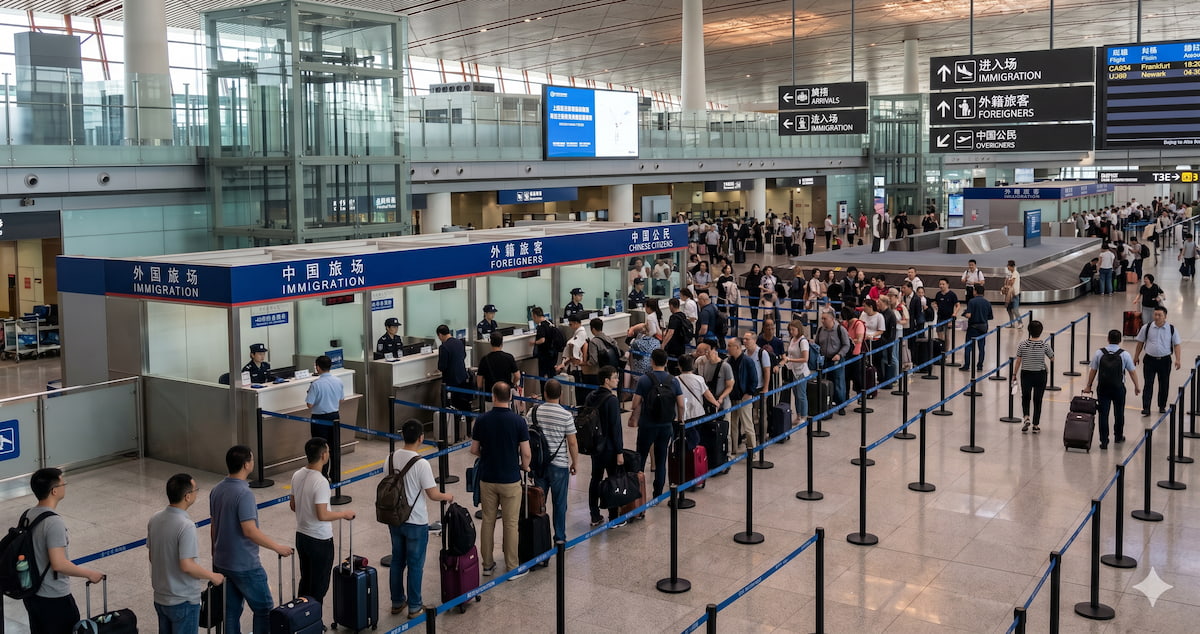
3. Clear immigration. Go to the “Transit Without Visa / 过境免签” lane — not the regular visa queue. Present:
- Passport (minimum 6 months validity from your China departure date; at least 1 blank page)
- Onward ticket (printed or on phone)
- Digital Arrival Card QR code
- Hotel booking (optional but recommended)
Your stamp shows the permitted departure date. Photograph it immediately. Do not lose this stamp — you will need it to exit.
4. Get to your accommodation. Key airport transfers:
- Shanghai PVG → city: Maglev to Longyang Rd (¥50, 8 min) + Metro Line 2. Total ~50 min, ¥60
- Beijing PEK → city: Airport Express to Dongzhimen. Total ~45 min, ¥25
- Beijing PKX (Daxing) → city: Daxing Airport Express. Total ~30 min, ¥35
5. Hotel check-in. The hotel must register your foreign passport with local police within 24 hours — compliant hotels do this automatically when they take your passport at check-in. If told “we don’t accept foreigners,” this is illegal at any licensed hotel. Ask for the manager or book elsewhere.
Common mistakes that cause denial
- Round-trip routing — Country A → China → Country A is not eligible under any circumstances
- Unconfirmed onward ticket — open-jaw, standby, or tickets without a confirmed seat are rejected
- No Digital Arrival Card — inability to produce the QR code causes delays or denial at the immigration counter
- Travel outside permitted regions — Tibet and Xinjiang are not covered; travelling there during a transit stay violates the terms
- Passport validity under 6 months — calculated from your planned departure date from China, not from arrival
The 72-hour exceptions
Three airports remain on the old 72-hour cap. The same clock calculation applies, but stays are capped at 3 full days:
- Guilin Liangjiang International — travel limited to Guangxi Zhuang Autonomous Region
- Harbin Taiping International — travel limited to Heilongjiang Province
- Changsha Huanghua International — travel limited to Hunan Province
A few more things
Leaving early — no penalty for departing before 240 hours expire.
Multiple transits — the policy can be used multiple times per year; each trip must independently satisfy the third-country routing requirement.
Airside transit under 24 hours — if you stay in the international transit area without clearing immigration, no card, stamp, or transit visa-free status is needed at all.
Emergency missed flight — contact the local Exit-Entry Administration before your stamp expires; they issue temporary stay permits in genuine force majeure cases.
Informational use only. This guide is not professional travel, legal, or financial advice. China's visa policies, entry requirements, and travel rules change frequently — always verify critical information with your country's embassy and official government travel advisories before making decisions. SinoSoloTravel accepts no liability for outcomes resulting from reliance on this content. Full terms →