Unlock the Logic of Chinese Menus
Affiliate Disclosure: This guide contains affiliate links — for VPN services (NordVPN, ExpressVPN, Surfshark), eSIM providers (Airalo), travel activities (Klook), and travel insurance (SafetyWing). If you click a link and make a purchase, we earn a small commission at no extra cost to you. We only recommend products we have personally tested. This does not influence our editorial ratings or rankings.
Menu layout — read front to back
Almost every Chinese restaurant menu follows the same order, from cover to back page:
Chef’s signatures → Cold appetisers → Hot dishes (by main ingredient: beef / pork / chicken / seafood / vegetables) → Tofu and egg dishes → Soups → Staples (rice / noodles / dumplings) → Desserts → Beverages
How to spot the signature dishes:
- Dishes framed with a red border, marked with a red seal, or flagged with a crown or star icon are the restaurant’s headline items
- Items labelled “Manager’s Pick” (店长推荐), “Crowd Favourite” (人气必点), “Top Seller” (销量第一), or “Limited Daily” (每日限量) have been validated by countless previous diners
- Items with large, high-resolution photographs are typically the flagship dishes — favour dishes with real customer photos over stock images, which can look very different from what arrives
- The last few pages often carry an “Executive Chef’s Recommendations” section — that’s where the restaurant’s real talent shows
Ordering without language skills
The following methods work better than any translation app, with a near 99% success rate.
The point-and-smile method — always works
- Walk over to a table whose food has just arrived, point at whatever looks good, and nod at the server
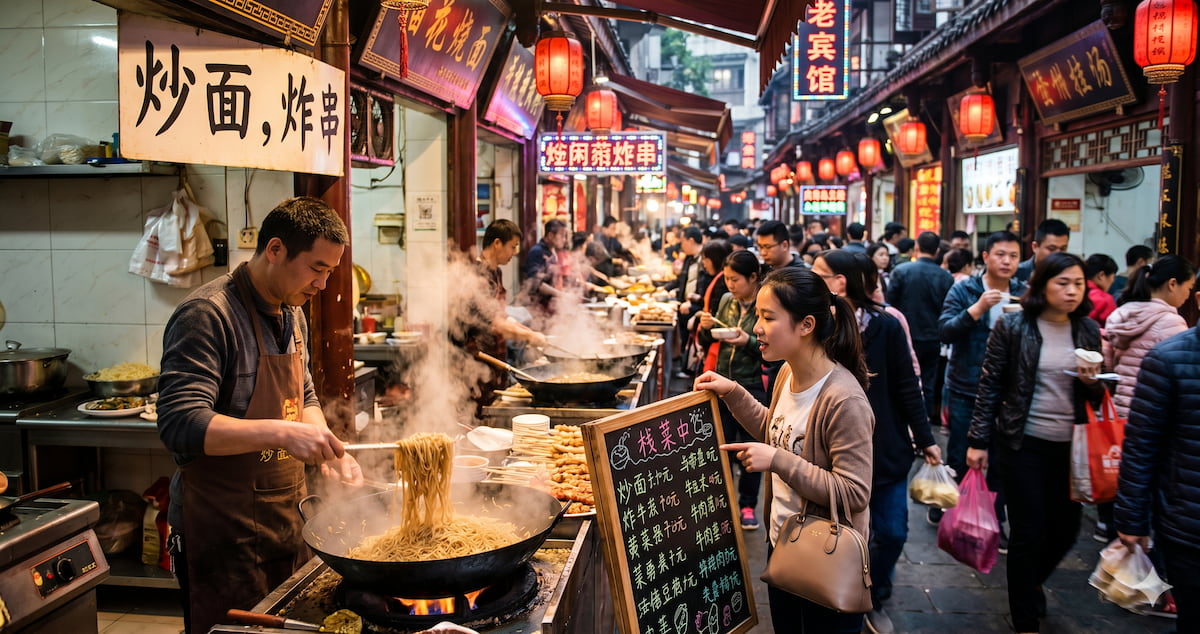
- If the restaurant has an open kitchen, point directly at a dish being prepared or already plated
- For larger groups, point at a nearby table’s full spread and say “the same as theirs” (和他们一样), adjusting quantity for your group size
Use Dianping
Open Dianping (大众点评), search for the restaurant, and look at the “Recommended Dishes” (推荐菜) ranking. Hand the phone to your server — this works everywhere and produces better results than improvised ordering.
Two foolproof questions
- Point to a dish and ask: Zhège hǎochī ma? — 这个好吃吗? (“Is this good?”)
- Ask the server directly: Nǐmen jiā shénme zuì hǎochī? — 你们家什么最好吃? (“What’s your best dish?”)
Price logic — by protein, not portion
Chinese restaurant pricing is consistent across the country. Prices are set by protein content, not serving size. The table below shows 2026 standard ranges for typical home-style restaurants — add 20% for first-tier cities; subtract 20% for third- and fourth-tier cities.
| Dish type | Price range (RMB) | Notes |
|---|---|---|
| Pure vegetable dishes | ¥20–¥40 | Stir-fried seasonal greens, cold cucumber salad |
| Egg and tofu dishes | ¥25–¥45 | Tomato and egg, mapo tofu |
| Pork and chicken dishes | ¥40–¥70 | Red-braised pork, kung pao chicken |
| Beef and lamb dishes | ¥50–¥90 | Sichuan boiled beef, cumin lamb |
| Freshwater fish | ¥60–¥120 | Steamed sea bass, pickled-cabbage fish stew |
| Seafood | Priced by weight | Usually marked “market price” (时价) — always confirm price and weight before ordering |
Important: for seafood, always ask Duōshǎo qián yī jīn? — 多少钱一斤? (“How much per jin?”) and confirm any preparation fee separately. “Creative dishes” with elaborate names and high prices almost always offer poor value. For group dining, ¥50–¥80 per person buys an excellent casual meal; anything over ¥100 per person should be a noticeably better establishment.
Regional flavour codes — same name, different dish
China is large enough that the same dish name can mean entirely different things in different provinces. Before ordering, identify which cuisine the restaurant represents.
The eight major regional cuisines:
| Cuisine | Core flavour | Key flavour notes | Signature dishes |
|---|---|---|---|
| Sichuan (川菜) | Numbing-spicy, savoury-aromatic | Numbing, spicy, hot, fragrant | Mapo tofu, water-boiled fish, kung pao chicken, twice-cooked pork |
| Hunan (湘菜) | Boldly spicy and rich | Dry-spicy, fresh-spicy, sour | Chopped-chili fish head, chili-fried pork, steamed cured meats, stinky tofu |
| Cantonese (粤菜) | Light, clean, true-to-ingredient | Fresh, tender, smooth, crisp | White-cut chicken, steamed fish, roast goose, har gow |
| Shandong (鲁菜) | Savoury and full-bodied | Salty, savoury, rich, fragrant | Braised sea cucumber with scallions, sweet-and-sour carp, Dezhou braised chicken |
| Jiangsu (苏菜) | Balanced sweet-savoury | Sweet, fresh, delicate, refined | Squirrel-shaped mandarin fish, clear-stewed lion’s head, salted duck |
| Zhejiang (浙菜) | Fresh, crisp, tender | Fresh, tender, light, fragrant | West Lake fish in vinegar gravy, Longjing shrimp, Dongpo pork |
| Fujian (闽菜) | Sweet-and-sour with depth | Fresh, fragrant, sour, sweet | Buddha Jumps Over the Wall, lychee pork, oyster omelette |
| Anhui (徽菜) | Savoury with light spice | Salty, savoury, fragrant, rich | Stinky mandarin fish, hairy tofu, Huangshan stewed pigeon |
Other popular regional cuisines:
- Xinjiang — cumin, lamb, and wheat-based staples. Signatures: lamb skewers, hand-pulled rice (polo), big-plate chicken
- Northeastern (Dongbei) — generous portions, bold savoury flavours. Signatures: guo bao rou (sweet-and-sour pork), di san xian (potato, eggplant, pepper), chicken stewed with mushrooms
- Shaanxi — sour, spicy, savoury, with a strong wheat tradition. Signatures: rou jia mo (“Chinese hamburger”), yang rou pao mo (lamb soup with torn flatbread), oil-splashed noodles
Cooking methods
The cooking method directly determines texture and flavour. Learn these and you’ll have a reliable sense of what you’re ordering before it arrives.
- 炒 (chǎo) — stir-fry. High heat, quick tossing, crisp-tender result. The most common preparation. Example: green pepper with pork
- 蒸 (zhēng) — steam. Cooked over steam; preserves natural flavour. Light and healthy. Example: steamed fish
- 煮 (zhǔ) — boil. Cooked in water. Examples: boiled eggs, noodles
- 炖 (dùn) — slow-stew. Long simmer over low heat; ingredients become tender and saturated with rich broth. Examples: red-braised pork, pork-rib soup
- 炸 (zhá) — deep-fry. Crisp exterior, tender interior. Examples: fried chicken, spring rolls
- 烤 (kǎo) — roast or grill. Cooked over open flame for an aromatic finish. Examples: lamb skewers, Peking duck
- 烧 (shāo) — braise. Pan-seared first, then stewed in sauce; yields a thick, glossy result. Examples: braised pork ribs, red-braised fish
- 白灼 (bái zhuó) — quick-blanch. Briefly cooked in boiling water and served with dipping sauce. Light and bright. Examples: blanched shrimp, blanched choy sum
- 干煸 (gān biān) — dry-sauté. Stir-fried until moisture cooks off, leaving a dry, intensely savoury result. Examples: dry-sautéed green beans, dry-sautéed beef
Dish names that don’t mean what they say
Many Chinese dish names carry cultural references. The literal translation often has nothing to do with what arrives at the table.
- 夫妻肺片 — Husband and Wife Lung Slices: No lung. Sliced cold beef tripe, heart, tongue, and head meat in chili oil.
- 鱼香肉丝 — Fish-Fragrant Pork: No fish. Pork in a sauce of pickled chilies, scallion, ginger, and garlic that evokes a “fish-flavoured” style.
- 狮子头 — Lion’s Head: Not a lion’s head. Large braised pork meatballs.
- 蚂蚁上树 — Ants Climbing a Tree: No ants. Glass noodles tossed with seasoned ground pork.
- 佛跳墙 — Buddha Jumps Over the Wall: A rich, layered stew of sea cucumber, abalone, and other premium ingredients — said to be so fragrant that even a meditating Buddha would jump the wall for a taste.
- 老婆饼 — Wife Cake: No wife. A flaky sweet pastry filled with winter melon and almond.
- 虎皮青椒 — Tiger-Skin Green Peppers: No tiger. Green peppers pan-blistered until the skin wrinkles like a tiger’s coat.
Essential ordering phrases
| English | Chinese | Pinyin |
|---|---|---|
| No spice, please | 不要辣 | Bù yào là |
| Mild | 微辣 | Wēi là |
| Medium spicy | 中辣 | Zhōng là |
| Very spicy | 特辣 | Tè là |
| No peanuts (allergy) | 不要花生 | Bù yào huāshēng |
| No garlic | 不要蒜 | Bù yào suàn |
| Less salt | 少盐 | Shǎo yán |
| Less sugar | 少糖 | Shǎo táng |
| The bill, please | 买单 | Mǎidān |
| One more of this | 再来一个 | Zài lái yī gè |
| Is this dish spicy? | 这个菜辣吗? | Zhège cài là ma? |
| How many people does this serve? | 这个菜适合几个人吃? | Zhège cài shìhé jǐ gè rén chī? |
| Can I take leftovers to go? | 可以打包吗? | Kěyǐ dǎbāo ma? |
| Do you have a private room? | 有没有包间? | Yǒu méiyǒu bāojiān? |
Group dining formula
When ordering for a group, follow this structure to ensure balance and avoid waste:
- Number of dishes: hot dishes = number of diners + 1 or 2; cold dishes = half the number of diners (round to an even number)
- Meat-to-vegetable ratio: 6:4 or 5:5 — avoid an all-meat or all-vegetable table
- Cooking method mix: combine stir-fry, steam, braise, and fry — don’t make everything stir-fried or everything deep-fried
- Must-have categories: 1 signature centrepiece dish + 2–3 regional specialties + 1 soup + 1 staple (rice, noodles, or dumplings)
- Portion guide: home-style restaurants serve generous portions. For 2–3 diners, 3–4 dishes is plenty; for 4–5 diners, 5–6 dishes is more than enough
China is a paradise for eating — every region has its own distinct flavour, and the occasional unfamiliar order is part of the experience. The best food is almost always in the small neighbourhood spots where locals eat, not in glossy tourist restaurants. Follow the locals and you’ll find the most authentic flavours.
Informational use only. This guide is not professional travel, legal, or financial advice. China's visa policies, entry requirements, and travel rules change frequently — always verify critical information with your country's embassy and official government travel advisories before making decisions. SinoSoloTravel accepts no liability for outcomes resulting from reliance on this content. Full terms →